Deloitte Football Money League / Our Current Predicament

CPFCSaturn

Member
Country
England
Deloitte recently published their 'Football Money League' for the 24/25 season.

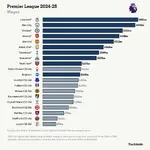
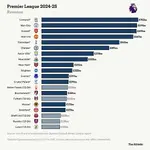
Other than really highlighting the ever-growing gap between the big boys and the rest, I think there's takeaways for us in both the 'Revenue' and the 'Wages' chart;

On wages; we are clearly very, very conservative - ranked 16th out of 17 in terms of the teams not just promoted into the division. I'd imagine that may have ticked up slightly for this season, but it does support the narrative that we are fairly unambitious in our recruitment and retention work. I think it also puts a fantastic perspective on just how good a job Glasner has been doing for the last few years - wage bill is by far the biggest correlator in football as to your success, and we're probably the best outperformers of it in the league over the last few seasons.

On the revenue side, the picture is far more nuanced than the prevailing narrative suggests. We sit much closer to the middle of the pack than many assume. Taken together, the two graphs don’t really support the argument that a lack of revenue is what fundamentally limits our competitiveness in the transfer market. Several clubs with comparable — or even lower — revenues appear willing to take on significantly more risk in how they allocate their spending, rightly or wrongly.

In short, our approach feels less like a structural revenue problem and more like a strategic choice about risk appetite, which makes Glasner's ongoing frustration more understandable to me.
 

Attachments

  • WhatsApp Image 2026-01-22 at 09.24.23 (1).webp
    WhatsApp Image 2026-01-22 at 09.24.23 (1).webp
    58.5 KB · Views: 43
  • WhatsApp Image 2026-01-22 at 09.24.23.webp
    WhatsApp Image 2026-01-22 at 09.24.23.webp
    84.1 KB · Views: 42
The big clubs wage bills are almost 4 times ours. How can you compete with that
this is something about football that makes me sad (diving, simulation and the pathetic theatrics when players aren't really hurt or touched is the other one). The governing bodies should have got hold of spiralling wages a long long time ago. It's out of control now, and beyond ever being able to be levelled or capped to a point where poorer teams can catch up.
 
So 12 in revenue and 17th in wages.

I wouldn't read tonnes into that. If JP and Guehi had agreed new contracts that would have bumped us up a couple of positions. Plus since then we've lost some low wages (e.g. Ward) and added Nketiah.

In reality we are about where we are supposed to be.

And the task of breaking into the top 8 is close to impossible. Newcastle in 8th, earning 140m more than us.
 
So 12 in revenue and 17th in wages.

I wouldn't read tonnes into that. If JP and Guehi had agreed new contracts that would have bumped us up a couple of positions. Plus since then we've lost some low wages (e.g. Ward) and added Nketiah.

In reality we are about where we are supposed to be.

And the task of breaking into the top 8 is close to impossible. Newcastle in 8th, earning 140m more than us.

Why not? We're the biggest 'overperformer' in the league in terms of wage expenditure - I think every club will have a 'if X signed a new deal, or if we signed X' type story.

I think clubs will be able to crack the top 8 for the odd season here or there (ie Forest last season), but agree with you that sustaining it regularly is pretty much impossible now.
 
Why not? We're the biggest 'overperformer' in the league in terms of wage expenditure - I think every club will have a 'if X signed a new deal, or if we signed X' type story.

I think clubs will be able to crack the top 8 for the odd season here or there (ie Forest last season), but agree with you that sustaining it regularly is pretty much impossible now.
Pretty sure infrastructure expenditure is not included in these loss/ FFP / Europe loss accounts. Therefore, if we could build a large stadium and fill it, we could start to compete. When you consider it, Everton may start to compete. I know they were big at stages in the past. Give it a couple of years and it could happen again. Likewise Villa.
 
Pretty sure infrastructure expenditure is not included in these loss/ FFP / Europe loss accounts. Therefore, if we could build a large stadium and fill it, we could start to compete. When you consider it, Everton may start to compete. I know they were big at stages in the past. Give it a couple of years and it could happen again. Likewise Villa.
It does count, and is the main reason why Everton fell short of FFP and were penalised.

The club decided their strategy was worth any penalty and they were right.
 
It does count, and is the main reason why Everton fell short of FFP and were penalised.

The club decided their strategy was worth any penalty and they were right.
I can be pretty sure in telling you that it does not count. Everton were in debt for other reasons. Too much wages, players with no sell on value. Dubious financial decisions. The stadium does not count or how, for instance, would both Everton and Spurs fair this year? They'd fail every year. They've spent billions. That's not going to be repaid any time soon.
Infrastructure does not count towards FFP.
 
Pretty sure infrastructure expenditure is not included in these loss/ FFP / Europe loss accounts. Therefore, if we could build a large stadium and fill it, we could start to compete. When you consider it, Everton may start to compete. I know they were big at stages in the past. Give it a couple of years and it could happen again. Likewise Villa.

The above charts have nothing to do with FFP or anything like that - they're just crude figures for revenue and wages.

The charts suggest that even with our current revenue (which is likely even higher now as a result of FA Cup/Community Shield and European Qualification), we could already be more competitive financially with some of our peers.
 
I can be pretty sure in telling you that it does not count. Everton were in debt for other reasons. Too much wages, players with no sell on value. Dubious financial decisions. The stadium does not count or how, for instance, would both Everton and Spurs fair this year? They'd fail every year. They've spent billions. That's not going to be repaid any time soon.
Infrastructure does not count towards FFP.
Not every year, just three maximum. IIRC Everton failed it in two consecutive seasons. From what I saw at the time the stadium costs were part of the picture. They are off-set in part by sponsorship and outside investment in the project, and the overall cost is spread out over time.
 
I can be pretty sure in telling you that it does not count. Everton were in debt for other reasons. Too much wages, players with no sell on value. Dubious financial decisions. The stadium does not count or how, for instance, would both Everton and Spurs fair this year? They'd fail every year. They've spent billions. That's not going to be repaid any time soon.
Infrastructure does not count towards FFP.

My understanding is the spend itself on stadia is exempted. So it does not count. BUT depending on how the financing is set up related costs like interest etc are not exempt in the same way. Everton likely had some combination of

1. Interest on stadium loans
2. Financing costs
3. Debt servicing
4. Cashflow pressure forcing player sales which did not come off
5. Tangential Operational losses caused by financing structure

So in a way the commercial decisions around the stadium move were responsible even if the direct capital expenditure is exempted.
 
My understanding is the spend itself on stadia is exempted. So it does not count. BUT depending on how the financing is set up related costs like interest etc are not exempt in the same way. Everton likely had some combination of

1. Interest on stadium loans
2. Financing costs
3. Debt servicing
4. Cashflow pressure forcing player sales which did not come off
5. Tangential Operational losses caused by financing structure

So in a way the commercial decisions around the stadium move were responsible even if the direct capital expenditure is exempted.
Indeed, this is largely correct. FFP and PSR do not include infrastructure costs. Yet, if there is interest on loans that will be included. As will future operating losses.
If you consider ourselves, the Academy did not count. Everton and Spurs stadia did not count. But the interest on loans did.
 
The above charts have nothing to do with FFP or anything like that - they're just crude figures for revenue and wages.

The charts suggest that even with our current revenue (which is likely even higher now as a result of FA Cup/Community Shield and European Qualification), we could already be more competitive financially with some of our peers.
Exactly right. FFP is not the holy grail of healthy club expenditure, it warps the picture of what each club is actually doing, and up to a point clubs that are willing to go over it when necessary will end up, in the long run, better off for it, something we have seen play out in real time.
 
I think it more displays our recent philosophy of 'buy potential' - these buys aren't one the highest on wages, and we do not buy finished product often. Brennan johnson the obvious exclusion to this list. Of our current crop of players, most were bought young, with development in mind and they have developed into the players who could demand higher wages. problem is that when that time comes, they would like to move on (Eze, olise, guehi). As I understand it, we offered Mateta higher wages - but not as much as he wanted. so these numbers show that, more than our lack of ambition.
 
I think it more displays our recent philosophy of 'buy potential' - these buys aren't one the highest on wages, and we do not buy finished product often. Brennan johnson the obvious exclusion to this list. Of our current crop of players, most were bought young, with development in mind and they have developed into the players who could demand higher wages. problem is that when that time comes, they would like to move on (Eze, olise, guehi). As I understand it, we offered Mateta higher wages - but not as much as he wanted. so these numbers show that, more than our lack of ambition.
It also shows that we could potentially hold on to more of those players… like Mateta as a great example, whilst still doing that same core strategy bringing up young potential.

This season the really vital things we needed were to hold onto who we had, and to introduce a handful of ready made additions who could just shore it up a bit. That’s where we were as a club based on the season just gone, and as these statistics prove, we did and do indeed have the funds to do it.

None of that would have stopped us from trying to grow players like Canvot or Esse if that is the strategy.
 
It also shows that we could potentially hold on to more of those players… like Mateta as a great example, whilst still doing that same core strategy bringing up young potential.

This season the really vital things we needed were to hold onto who we had, and to introduce a handful of ready made additions who could just shore it up a bit. That’s where we were as a club based on the season just gone, and as these statistics prove, we did and do indeed have the funds to do it.

None of that would have stopped us from trying to grow players like Canvot or Esse if that is the strategy.
The issue with JPM, Guehi and Eze isn’t just wages though. They wanted to go to bigger clubs. Wages were part of that but not the whole story. We repeatedly offered Guehi and JPM new contracts on bigger wages and they said no. So it’s all well and good saying we should have held onto what we have but players have agency and if they really want to leave there isn’t much we can do regardless of funds
 
Interesting stuff. Of course, there isn't a chart here for transfer fee spending, which is as important in building a picture as wages.

Something else very important within FFP and PSR, at least to my limited understanding, is that they do allow a degree of debt over a three year period (I think £105m). A simple chart showing wages and transfer expenditure wouldn't necessarily show who was going into debt, who wasn't, and who was paying debt off to satisfy FFP.

Taken over any one season in isolation, Team A might be spending more than Team B, even though the two have similar revenues. However, that might be because Team B went into their permitted debt two years ago and are paying it back. In other words, Team A and Team B could be similar clubs in terms of budget, but be at different points in a three year FFP cycle. One of them looks bold and ambitious, the other cautious and conservative, but come back a year or two later and it's the other way around. Just depends where they are in their cycle.

I've never seen a good source of information that captures a teams actual spending power for a given season, taking into account their current position under FFP. The information must exist. Apparently clubs refer to it when negotiating transfers (as in, you might offer less for a player if you know the selling club is desperate because they are tight on FFP).

Finally, as relevant as it is to compare palace to other teams, personally I'm always more interested in the clubs accounts. They generally tend to show that the club spends all the money it can, sometimes a tiny bit more. That's probably the most relevant factor, though again, it doesn't really tell you where palace are with FFP at the time.
 
Last edited:

Holmesdale Online Shop

Back
Top