
Only black people? What about all the other non-white folks, although in actuality, I don't think there ever been a truly black man of African descent, Lennie Henry went close in the 70's with the Minstrels.

You are using an out of date browser. It may not display this or other websites correctly.
You should upgrade or use an alternative browser.
You should upgrade or use an alternative browser.
Immigration
- Topic starter Rudi Hedman
- Start date
Yup.I need to look that up on Google?

Stirlingsays
Member
- Country
 England
Yup.
I'll pass thanks.

ASCPFC
Member
- Location
- Pro-Cathedral/caravan park
- Country
 Ireland
Is there a collective noun for Bowls players?
Teddy Eagle
Member
- Country
 Scotland
A Hatfull of Bowlers?Is there a collective noun for Bowls players?
Good.I'll pass thanks.
A forest?A Hatfull of Bowlers?

georgenorman
Member
- Country
-
England
I think it is a case of bowels for that particular player.Is there a collective noun for Bowls players?
Teddy Eagle
Member
- Country
-
Scotland
Irritable Bowls Syndrome.I think it is a case of bowels for that particular player.
Stirlingsays
Member
- Country
-
England
Is there a collective noun for Bowls players?
A maintenance of bowlers?
chris123
Member
- Location
- hove actually
- Country
-
England
A Plymouth HoeIs there a collective noun for Bowls players?

palace_in_frogland
Member
- Location
- In a broken dream
- Country
 France
A narcolepsy of bowls players.Is there a collective noun for Bowls players?
palace_in_frogland
Member
- Location
- In a broken dream
- Country
-
France
Rhyming? Castor and Pollux?What a load of Castor. Haha!
You should have delved deeper when looking it up on google, mate.
Stirlingsays
Member
- Country
-
England
If any ignorant or fool denies that white replacement is happening in these isles then direct them to the stats....this being one of them.
All the left or social liberals....hell anyone other than something like Restore have to do....is wait until they reach voting age. Then they won't even have to bother lying to you.
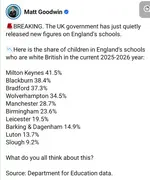
All the left or social liberals....hell anyone other than something like Restore have to do....is wait until they reach voting age. Then they won't even have to bother lying to you.
Last edited:

Jordan555x
Member
- Location
- Bromley
- Country
-
England
TrueGeordie being bang on the money yet again.
Stirlingsays
Member
- Country
-
England
TrueGeordie being bang on the money yet again.
Proper video.
Well said that man.
Wisbech Eagle
Member
- Location
- Truro Cornwall
- Country
-
England
I am glad you find it amusing. It’s entirely based on how I perceive the way others in the real world respond to me. Only this afternoon I played bowls against an old friend who I haven’t spent much time with in recent years. His wife has dementia and until fairly recently he was caring for her at home and consequently had no time for anything else. She is very ill, non verbal, non compliant and hasn’t recognised him for a long time. He had resisted placing her in a care home but I had encouraged him to seriously consider it, as I thought both of them would benefit. Eventually he has taken my advice and today thanked me for the insight. They are both benefitting. She is getting the care she needs, he is visiting but is now free to resume his life. He beat me though!I do love it when you describe yourself and how others see you.
Most amusing.
As for those who play bowls, I'm sure there are plenty of nice people who do it.....but the stereotype is for arrogant and aloof boomers.
As for knowing more than you.....blimey, there are schoolchildren who make more sense. Most of your predictions fall on their arse...Russiagate, Trump wining, Ukraine, Reform.
In fact just taking against your declared opinions and then just waiting for time to pan out makes most people look like geniuses.
I know no arrogant or aloof bowlers. One or two loudmouths that’s true, but mostly it’s a supportive community across different clubs. Mind you, you obviously know better than me. You know better than everyone else about everything.
I make predictions. You ignore facts. Russiagate was real. Trump won a second term. Against all logic in an attempt to avoid jail. He is a convicted felon who would have been convicted of much more serious offences had he not been elected. Now he is so unpopular that time alone will tell what happens when he leaves office. Jail or a care home seem most likely.
Ukraine are standing up to the Russians really well. Putin is as dogmatic as ever but beneath the surface the Russian economy is creaking. Don’t be surprised if there is another serious attempt to destroy the Chonhar Bridge, which is Putin’s pride and joy. Not just damage it, but render it unusable, cutting off all supplies to Crimea and the resupply of much of their army.
Wisbech Eagle
Member
- Location
- Truro Cornwall
- Country
-
England
It’s simply untrue. There is no need for camouflage. You are the one taken in by the rhetoric and misinformation from the right. It’s they who claim it “amounts” to something else. It doesn’t.It isn't a debate: there are guidelines differentiating on people's skin colour. They amount to treating a white person less favourably than a person of colour. No one is even denying that. People are trying to camouflage it and you seem to be entirely taken in by that.
All of this comes from the MacPherson report. Parts of which are being taken out of context. This comes from an AI query:-
“The police guidance from the Macpherson Report fundamentally redefined the relationship between the police and ethnic minorities. It introduced the concept of "institutional racism" and mandated a shift from simply avoiding discrimination to actively providing a professional, fair service to all .
This is the practical meaning of its core requirements:
1. Stop and Search Must Be Justified
The report stated that the disproportionate stopping of Black people (nine times more likely than White people) was driven by "racist stereotyping" . It mandates that the police cannot simply explain away these disparities; they must actively eliminate the discrimination causing them .
2. Beyond Intent: Measuring "Unwitting Prejudice"
The guidance requires forces to audit their processes for "unwitting prejudice" . Even if no individual officer is intentionally racist, if the outcome of a policy (like stop-and-search) disadvantages minorities, the organization must change that process.
3. Recording and Transparency
The report mandated that all "stop and account" encounters be recorded, not just formal searches . The goal is to create a data trail to hold forces accountable for how they use their authority.
4. The "Perception" Rule for Racist Incidents
It established that an incident is racist if the victim (or any other person) perceives it to be so . This places a duty on officers to believe the victim's lived experience rather than making a legal judgment on the spot.
Does it mean police must hit diversity quotas?
It means police forces should reflect the ethnic mix of the communities they serve . The goal is that by 2009, 9% of officers should be BAME (matching the population then). This has not been achieved, with current representation at 6.6% vs a 14% BAME population .
How does this actually affect a police officer on the street?
It means an officer cannot stop someone just because they fit a "profile" of an offender based on race. They must rely on specific intelligence or behavior. The law hasn't changed, but the standard of proof and the scrutiny applied to their decision-making have increased drastically .
Has the guidance been successful?
· The Gap Widened: In 1997/98, Black people were 5x more likely to be stopped than Whites. By 2020, this rose to 9x .
· Confidence is Low: Public confidence among Black communities has actually fallen since the report, widening the "trust gap" .
· Systemic Problems: The UK Parliament concluded in 2021 that the lack of progress points to a "structural and systemic problem" still present in policing .
The guidance requires the police to work harder to prove they are fair rather than simply assuming they are. It places the burden on the institution to eliminate disparities, regardless of intent.”
Nothing in the report and the guidance which flowed from it results in ethnicity playing any role in determining how criminality is determined and dealt with. Everything in the report is the antithesis of that. It is to stop discrimination. Not introduce it.
cryrst
Member
- Location
- The garden of England
- Country
-
England
I knew context would be mentioned early on. It’s the equivalent of swerve in your thesaurus.It’s simply untrue. There is no need for camouflage. You are the one taken in by the rhetoric and misinformation from the right. It’s they who claim it “amounts” to something else. It doesn’t.
All of this comes from the MacPherson report. Parts of which are being taken out of context. This comes from an AI query:-
“The police guidance from the Macpherson Report fundamentally redefined the relationship between the police and ethnic minorities. It introduced the concept of "institutional racism" and mandated a shift from simply avoiding discrimination to actively providing a professional, fair service to all .
This is the practical meaning of its core requirements:
1. Stop and Search Must Be Justified
The report stated that the disproportionate stopping of Black people (nine times more likely than White people) was driven by "racist stereotyping" . It mandates that the police cannot simply explain away these disparities; they must actively eliminate the discrimination causing them .
2. Beyond Intent: Measuring "Unwitting Prejudice"
The guidance requires forces to audit their processes for "unwitting prejudice" . Even if no individual officer is intentionally racist, if the outcome of a policy (like stop-and-search) disadvantages minorities, the organization must change that process.
3. Recording and Transparency
The report mandated that all "stop and account" encounters be recorded, not just formal searches . The goal is to create a data trail to hold forces accountable for how they use their authority.
4. The "Perception" Rule for Racist Incidents
It established that an incident is racist if the victim (or any other person) perceives it to be so . This places a duty on officers to believe the victim's lived experience rather than making a legal judgment on the spot.
Does it mean police must hit diversity quotas?
It means police forces should reflect the ethnic mix of the communities they serve . The goal is that by 2009, 9% of officers should be BAME (matching the population then). This has not been achieved, with current representation at 6.6% vs a 14% BAME population .
How does this actually affect a police officer on the street?
It means an officer cannot stop someone just because they fit a "profile" of an offender based on race. They must rely on specific intelligence or behavior. The law hasn't changed, but the standard of proof and the scrutiny applied to their decision-making have increased drastically .
Has the guidance been successful?
· The Gap Widened: In 1997/98, Black people were 5x more likely to be stopped than Whites. By 2020, this rose to 9x .
· Confidence is Low: Public confidence among Black communities has actually fallen since the report, widening the "trust gap" .
· Systemic Problems: The UK Parliament concluded in 2021 that the lack of progress points to a "structural and systemic problem" still present in policing .
The guidance requires the police to work harder to prove they are fair rather than simply assuming they are. It places the burden on the institution to eliminate disparities, regardless of intent.”
Nothing in the report and the guidance which flowed from it results in ethnicity playing any role in determining how criminality is determined and dealt with. Everything in the report is the antithesis of that. It is to stop discrimination. Not introduce it.
Teddy Eagle
Member
- Country
-
Scotland
That might be what the MacPherson report said but does the policy developed from it say the same?It’s simply untrue. There is no need for camouflage. You are the one taken in by the rhetoric and misinformation from the right. It’s they who claim it “amounts” to something else. It doesn’t.
All of this comes from the MacPherson report. Parts of which are being taken out of context. This comes from an AI query:-
“The police guidance from the Macpherson Report fundamentally redefined the relationship between the police and ethnic minorities. It introduced the concept of "institutional racism" and mandated a shift from simply avoiding discrimination to actively providing a professional, fair service to all .
This is the practical meaning of its core requirements:
1. Stop and Search Must Be Justified
The report stated that the disproportionate stopping of Black people (nine times more likely than White people) was driven by "racist stereotyping" . It mandates that the police cannot simply explain away these disparities; they must actively eliminate the discrimination causing them .
2. Beyond Intent: Measuring "Unwitting Prejudice"
The guidance requires forces to audit their processes for "unwitting prejudice" . Even if no individual officer is intentionally racist, if the outcome of a policy (like stop-and-search) disadvantages minorities, the organization must change that process.
3. Recording and Transparency
The report mandated that all "stop and account" encounters be recorded, not just formal searches . The goal is to create a data trail to hold forces accountable for how they use their authority.
4. The "Perception" Rule for Racist Incidents
It established that an incident is racist if the victim (or any other person) perceives it to be so . This places a duty on officers to believe the victim's lived experience rather than making a legal judgment on the spot.
Does it mean police must hit diversity quotas?
It means police forces should reflect the ethnic mix of the communities they serve . The goal is that by 2009, 9% of officers should be BAME (matching the population then). This has not been achieved, with current representation at 6.6% vs a 14% BAME population .
How does this actually affect a police officer on the street?
It means an officer cannot stop someone just because they fit a "profile" of an offender based on race. They must rely on specific intelligence or behavior. The law hasn't changed, but the standard of proof and the scrutiny applied to their decision-making have increased drastically .
Has the guidance been successful?
· The Gap Widened: In 1997/98, Black people were 5x more likely to be stopped than Whites. By 2020, this rose to 9x .
· Confidence is Low: Public confidence among Black communities has actually fallen since the report, widening the "trust gap" .
· Systemic Problems: The UK Parliament concluded in 2021 that the lack of progress points to a "structural and systemic problem" still present in policing .
The guidance requires the police to work harder to prove they are fair rather than simply assuming they are. It places the burden on the institution to eliminate disparities, regardless of intent.”
Nothing in the report and the guidance which flowed from it results in ethnicity playing any role in determining how criminality is determined and dealt with. Everything in the report is the antithesis of that. It is to stop discrimination. Not introduce it.